Physics-based AI Agent
Our AI agents combined with specialized LLM and trusted code base maps problem descriptions to a differentiable design engine rather than a static simulation software!
Problem
Solution
What Do We Offer
Our AI agents combined with specialized LLM and trusted code base maps problem descriptions to a differentiable design engine rather than a static simulation software!
Our design engine can optimize billions of parameters at the same time, achieving 10-1000x speedup that saves time and resources!
From concept to validation, we bridge research and manufacturing, and for the first time in the industry, we deliver a fully transparent, customizable, and extensible design engine not a ridiculous black box!
COST Saving
Assume we want to optimize 1 billion parameters in the magnet design of a fusion device or geometry of a space travel vehicle, and each simulation run takes 1 hour on an NVIDIA A100 40GB. Following is the approximate breakdown of GPU hours and costs for different approaches in each iteration of engineering design cycle:
| Approach | Compute Plan | GPU Hours | Cost in USD | Update Strategy |
|---|---|---|---|---|
| Brute force | 1b simulations x 1h each | 1,000,000,000 | ~$1,290,000,000 | One parameter at a time |
| Data-driven | 100k simulations + 500 epochs | 100,500 | ~$129,645 | Train surrogate, then optimize |
|
Differentiable programming GradusX |
500 differentiable runs | 500 | ~$645 | Update of all parameters together |
Illustrative estimate using $1.29 per GPU-hour (NVIDIA A100 SXM 40GB on Lambda Cloud, pricing effective February 23, 2026). For the data-driven row, training is approximated as 1 GPU-hour per epoch.
References to differentiable programming and data-driven optimization in scientific computing:
Comming Soon
CURRENT DELIVERY
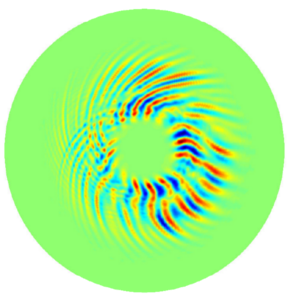
GradusX is delivering a high-performance and portable ORB5X codebase to the Swiss Plasma Center, enabling more efficient simulation workflows for Tokamak research and design. The original ORB5 codes is a global, gyrokinetic, electromagnetic, multi-species code based on a Lagrangian variational description, discretized with a particle representation of the distribution functions and a finite element representation of the fields.
Team is ex-



Supported by



Contact: admin@GradusX.com